Living with an unwanted change in your appearance isn’t easy. Hair loss can affect your mental health and social life.
As dermatologists, we do not trivialise hair loss. We recognise the impact it can have on your life and seek to provide evidence-based treatments for it, which can include hair transplantation.
What is a hair transplant?
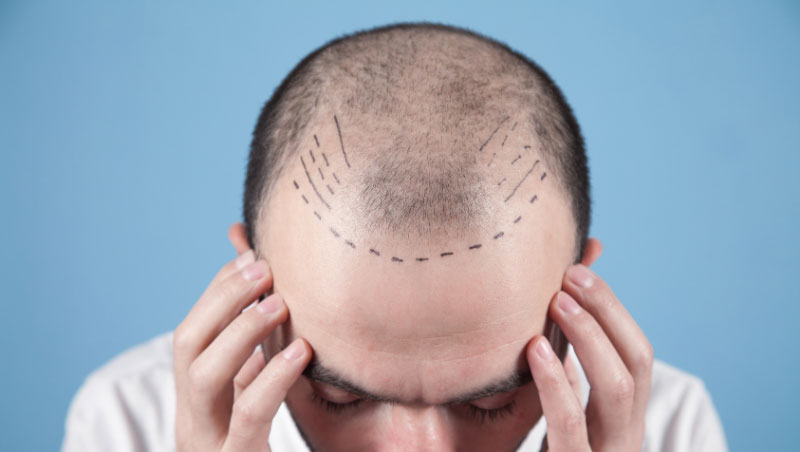
A hair transplant is a type of cosmetic surgery where hair follicles are taken from one part of your body (usually the back or sides of your scalp) and carefully implanted in areas with thinning or no hair. It aims to create natural, permanent hair that grows just like the rest of your hair.
At Sinclair Dermatology, we practice FUE (Follicle Unit Extraction). This technique involves removing individual grafts and moving them to bald areas.
A hair transplant is not a complete cure for baldness. It may be a permanent solution for the area treated but most patients will need to take medication to slow down possible hair loss from other areas of the scalp.
Who can benefit from hair transplantation?
Hair transplants may be suitable for people experiencing:
- Male pattern baldness
- Female pattern hair loss
- Traction alopecia
- Some forms of scarring alopecia
- Hair loss after injury or burns
- Eyebrow or beard hair loss
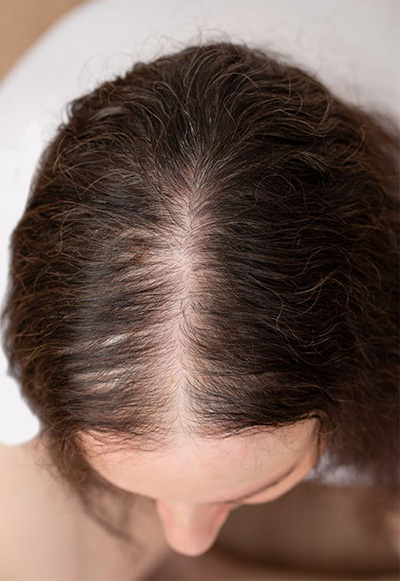
We also provide hair transplants for women, tailored to different patterns of hair thinning, which often require a more nuanced approach.
Hair transplant for women: A tailored approach to female hair loss
Unlike male pattern baldness, which usually presents as a receding hairline or bald crown, female hair loss often appears as generalised thinning across the scalp, particularly along the part line. This means restoration often focuses on the crown and top of the head.
We provide customised hair transplants for women. Before surgery, your dermatologist will assess you carefully to rule out any underlying hormonal issues, mineral deficiencies or autoimmune conditions that could be contributing to your hair loss.
Your treatment journey at Sinclair Dermatology
Step 1: Comprehensive consultation
Your journey starts with an assessment by a qualified dermatologist. We consider your hair loss pattern, scalp condition, medical history, and expectations.
Step 2: Customised treatment plan
If you are a candidate for hair transplantation, we will explain your options and expected outcomes, including recovery time and potential side effects.
Step 3: Hair transplant procedure
The procedure is performed in our clinic under local anaesthetic. It may take 8-12 hours, depending on the number of grafts.
Step 4: Recovery and follow-up
You will usually wear a bandage or dressing for 1-2 days, after which you may be able to return to work. It is important to avoid exercise or strenuous activity for about 14 days.
During your recovery, you may experience:
- Bruising and swelling
- Possible numbness
- Pain, throbbing and discomfort
- A tight feeling in the scalp
- Scabs in the recipient and donor areas
Your dermatologist will provide detailed post-procedure instructions and ongoing care to support healthy regrowth.
Are there any risks or complications?
Any surgical or invasive procedure involves risks. Possible issues include:
- Risk of allergy caused by anaesthesia
- Surgical risk, such as bleeding or infection
- Scars that may be severe, raised, reddened and itchy
- Nerve damage
- Shock loss
- Tissue death In the recipient area
Underlying medical conditions or lifestyle habits like smoking can also affect your recovery. It is important to discuss these matters with your dermatologist before your surgery.
If you do experience any bleeding, severe pain or unusual symptoms during your recovery, please contact us immediately.
Hair transplant costs
Costs for a hair transplant in Melbourne depend on several factors including:
- The number of grafts required
- The technique used
- The complexity of your condition.
During your consultation, we will provide transparent pricing tailored to your needs.
Are there rebates for a hair transplant?
No. A hair transplant is considered a cosmetic procedure and, as such, it does not usually qualify for a rebate from Medicare or private health insurers.
If your hair loss was caused by burns or trauma, your hair transplant may be considered reconstructive rather than cosmetic – in those circumstances, your health insurance may contribute towards it (depending on your level of cover).